All posts by sarah

Naming Parts of the Body

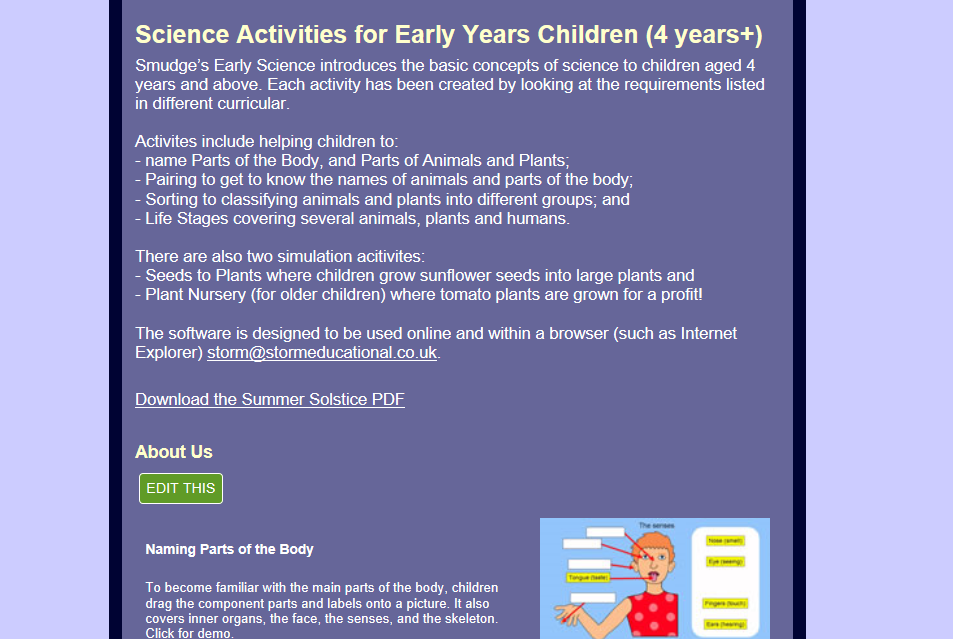
The science curriculum for early science states that as part of understanding living things and life processes, children should be able to recognise and compare the main external parts of the bodies of humans. The Parts of the Body activity is a way that children can get to know the names of the main parts of the body by putting body parts and labels onto a picture of the body. There are topics covering:

  • (external) parts of the body
  • parts of the face
  • senses
  • skeleton
  • inner organs of the body

The picture shown on the left side of the screen can be completed by dragging the component parts (ribs, skull etc.) from inside the white box on the right and placing them into position on main picture. When all of the parts have been placed, a number of labels will be shown, which can also be added onto the picture in a similar way. All of the children’s tries will be recorded, and the total number of correct and incorrect answers can be viewed.
Naming Parts of Plants and Animals

Where is the trunk on a tree? What is the name of the colourful parts of a flower? Do butterflies have legs? One of the basic starting points in early science is for children to become familiar with the basic structure of plants, trees and different types of animals, which this activity teaches in a simple and interesting way.

Naming Parts of Plants and Animals covers:

  • A flower
  • A tree
  • A wilted flower
  • A horse
  • A butterfly

For each of these topics, a picture shown on the screen is completed by dragging the different parts (petal, leaf, roots, stem etc.) from the right of the screen and placing them into the correct position. When all of the parts have been placed, labels can be added in a similar way, and children can click on the labels to hear and read more about that part of the plant or living creature.

Naming Parts of Plants and Animals works at the pace of children, so that children can stop and think, or ask questions of an adult. All of the children’s attempts will be recorded, so that a teacher or parent can view the total number of correct and incorrect answers, and it can be used in either English or Spanish

Naming Parts of Plants and Animals provides children with the foundation understanding for further investigations into the natural world.

New website

As you can see, our website has a new look to it, thanks to the hard work by Sarah Longworth. The new site shows our new science activities in our new subscription site, and available for use on tablets. Our old web pages, with details about our CD-ROM titles are still available by clicking on the CDROM tab.

Online subscription servive

We have also launched an online subscription service called “Smudge’s Early Subscription siteScience” where our brand new interactive science activities, and support material can be used online. This is available by a secure login page, and cost just £20 + VAT for individual apps or £100 + VAT for all of the apps for a 12 month subscriptions for the whole school. Login here

We Love Science walks Offa’s Dyke

Will had a much needed week off from running our social media and walked 81 miles along Offa’s Dyke on the Welsh/English border. In a change to the usual science blog posts, he tells his story in the current entry in the We Love Science blog
welovescience_logo_big

Sorting for Early Science

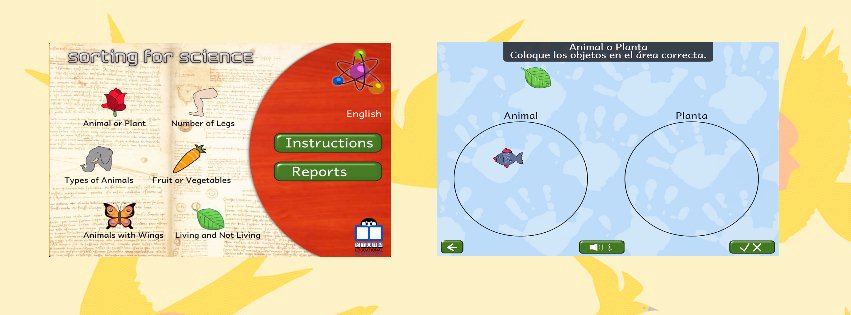
Sorting for Early Science builds on children’s natural curiosity for objects and animals in the world around them. Is a pear a fruit of a vegetable? Does a  penguin have wings?

Having the ability to classify, or sort, items is an important scientific skill specified in the early years curriculum. This colourful, fun app helps children develop this ability, whether they are working alone or in small groups. It provokes lively classroom discussion, with children asking each other if they have seen a bat.or working out how to tell a fruit from a vegetable.
Children classify items according to whether they are:

  • Animals or Plants
  • Types of Animals
  • Animals with Wings or No Wings
  • Number of Legs
  • Fruit or Vegetable
  • Living or Not Living

This is done by dragging objects from the top of the screen into one of the labelled circles on the screen. For some topics, there are overlapping circles for items that can go into more than one circle.

There is a reporting option to allow adults to monitor the progress of children. Children can build their basic vocabulary, either in English, or in Spanish as the app can be switched between both languages.


Pairing for Early Science

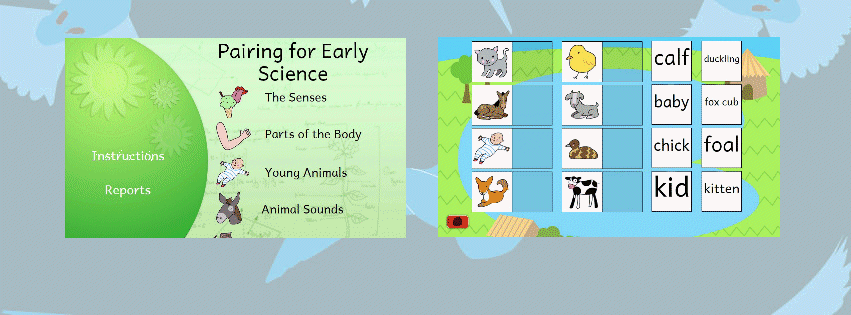
“Pairing for Early Science” helps children get a start on knowing basic science related vocabulary. It teaches children words for fruit and vegetables, body parts, animals – and the noises they make. With this knowledge, children can start asking basic questions about the world around them, preparing them for the next stage in their scientific education.

In “Pairing for Early Science”, children move and match cards from the right of the screen and place them next to the matching cards on the left of the screen. With most topics, children match words with pictures, and in one of the topics, children match animals sounds with pictures of the animals.

There is a reporting option to allow adults to monitor the progress of children and an animation of Smudge when all the items have been placed


Online Subscription Service

Smudge’s Early Science is an online subscription service containing all of our interactive science activities for children aged 4 to 11 years old.

The activities will to help children develop their basic knowledge about science- such as naming parts of the body, or plants or animals or the life stages of different creatures; and also learning about the concepts, with simulation activities such as growing a sunflower, creating a sundial, using bottles to create musical sounds.

The activities have been created by studying the updated requirements of the science Curricular in England, Scotland, Wales and Northern Ireland.

The full details of each activity can be found here

With schools increasingly using a mix of new tablets and mobile devices alongside existing classroom computers, Smudge’s Early Science uses the latest HTML5 technology, which means it can run on desktop computers, whiteboards just as well as on an iPad or Android tablet.

The software is also available through RM Unify.

A demo version of the activities is available here

Life Stages

How does a caterpillar turn into a butterfly? a tadpole turn into a frog? Let children discover the life stages of many types of animal with this first science app.

Knowing about the life stage of different creatures is an important basic/science topic children must cover in their early years. This activity will provide children with a greater understanding of life cycles within different species, and to demonstrate how each step leads to the next. The colourful images of tadpole, caterpillar and hatching egg enable children to visually recognise each stage and apply their new vocabulary.

Life Stages covers six different creatures: butterfly, chicken, flower, frog, human and tree. For each of these topics, children select, or scroll through, colourful images of one of the stages in the life process, which they drags into the correct position in the sequence at the top of the screen. At the easy level, the names of the stages are shown at the top of the screen. Once an image has been placed correctly, there is the ability to learn even more about each stage: by clicking the speaker button, children can learn, for example, how the butterfly emerges from the cocoon and when the frogspawn becomes tadpoles.

Some of the features of Life Stages are:

  • Children work at their own pace.
  • Life Stages supports the schools curriculum in the area of life sciences, and will help develop children’s interest in the world around them.
  • It gives children practice in ordering events into a sequence
  • It’s simple and quick to start – no long introductions or fiddly setups
  • It has a reporting option
  • It works in English and Spanish, which has the additional benefit of helping children with their second language
  • It has on-screen instructions, audio help and an option page to change the level of difficulty


Read full post

Life stages

This activity will help children understand the different stages that humans and animals (frogs, butterflies and chicken) go through by placing pictures in order, which can be written about. The support materials also covers the Life Stages of Plants. Click for demo.